The Thoracic Sling – Why Your Horse May Suddenly Look Taller
🥰One of the most common things I hear from clients is:
🌟“My horse looks like he’s grown since we started working with you!”🌟
🌟“His head and neck feel so much lighter in my hands!”🌟
There’s a reason for this; it’s a change that’s not accidental!
💪🏻After manual therapy, I incorporate targeted exercises aimed at improving neuromuscular activation, symmetry, and functional strength, targeting weaker areas. As these structures become stronger and more efficient, the thorax is better supported and elevated — creating the appearance of increased height, and improved balance and posture.
👉🏻But let’s break down why this matters…
🤔💭Did you know horses have no collarbone?
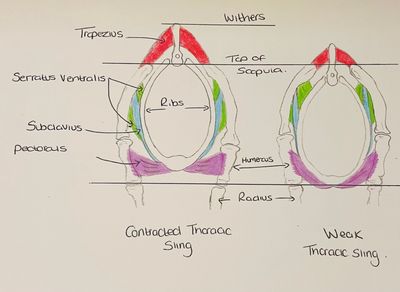
This means the forelimbs have no bony attachment to the axial skeleton but instead the entire forehand is suspended by a complex group of muscles and connective tissues known as the thoracic sling (including serratus ventralis, pectorals, subclavius, and associated structures -see my drawing attempt😂).
☹️When these muscles are weak, this whole area literally drops between the shoulders. This can lead to:
• Postural imbalance and reduced shoulder freedom
• Increased load on the forelimbs
• Bracing through the Trapezius, leading to tight, sore, overworked shoulders
• Strain through the entire musculoskeletal system
• Compensatory patterns elsewhere in the body
• A “downwards posture,” heaviness in the hands, or a horse that feels like it’s “falling forward”
😭In some cases, attempts to create an artificial “outline” or being “on the bit” by pulling the head and neck in only make these compensations worse. This reduces true self-carriage and can create long-term discomfort and dysfunction.
💡Integrating the Whole System...
Optimal posture and movement require coordinated function between:
• The thoracic sling
• Thoracic and lumbar spinal flexion
• Lumbosacral articulation
• Core musculature (multifidus, transversus abdominis, obliques, iliopsoas, etc.)
💪🏻When these components work together, the horse can then achieve:
• Lifting of the forehand and freeing of the Trapezius
• Effective biomechanical engagement
• Efficient scapula glide- improving shoulder freedom and therefore gait quality
• Improved load distribution
• Reduced risk of soft-tissue and postural injuries
……And ultimately be happier and more comfortable in their work.
🤗 This holistic approach — combining manual treatment with targeted strengthening — is what allows the horse to carry the thorax higher, move more freely, and maintain balance without relying on tension or forced head carriage.
📩If you’re interested in identifying your horse’s weaker areas and supporting long-term soundness through correct conditioning, feel free to contact me. I’m always happy to help your horse move and perform at their best. 🐴💓